Font-Size
Contrast
Blue-Filter
Jump directly to main navigation Jump directly to content Jump to sub navigation

Laser triangulation sensors measure the thickness of metal wheel rims

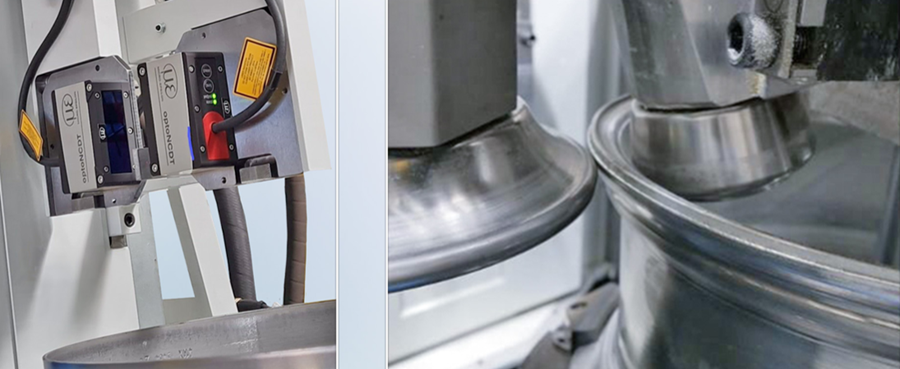
In the production of metal wheels using the flow-forming process, it is necessary to check the thickness distribution on the round body after each deformation step. This helps to comply with the target dimensions, ensuring high product quality and cost-effectiveness. For this measurement task, the manufacturer uses optoNCDT laser triangulation sensors from Micro-Epsilon. The sensors are designed for dynamic measurement tasks in industrial environments and offer an economical solution with high measurement accuracy.
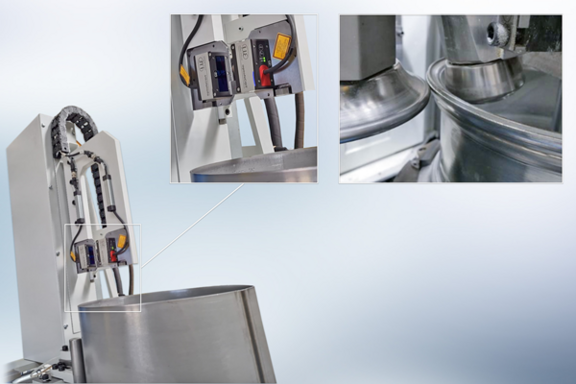
 

Flow forming is an advanced cold-rolling metalworking process that shapes a cylindrical “preform” into a thinner, longer and stronger component by using CNC rollers to force the material against a mandrel. As the material is stretched, the ‘flow’, over the mandrel it reduces in thickness which needs to be measured to ensure an optimum final product is produced.

For the measurements, two optoNCDT 1900-10 laser sensors with a measuring range of 10 mm are used. Ideally suited for both dynamic and high resolution measurement tasks, the laser sensors are completely self-contained in a compact housing with innovative mounting sleeves that ensures a repeatable sensor position and alignment to the target. The sensors are ideal for high speed distance, displacement and position measurements in a wide range of automation tasks, including machine building, robotics, automotive production, 3D printing and coordinate measuring machines.

Measure on almost any surface

The sensors work with the Advanced Surface Compensation (ASC) algorithm, which allows them to operate almost regardless of the target material and colour. The exposure time or amount of light produced by the laser sensor is optimally matched to the reflection characteristics of the target surface, which enables reliable measurements even on difficult, changing surfaces. The sensor is extremely resistant to ambient light interference and so can be used in high illumination environments including those situations where lasers are combined with Vision Systems and their associated LED lighting. The new software algorithms compensate for ambient light up to 50,000 lux, which means operation in direct sunlight is also improved.

With a repeatability of 5 μm and a measurement rate of up to 10 kHz, the sensors perform consistently fast and precise measurements of the rim thickness. Due to the IP67 protection class and high shock and vibration resistance, the sensors are ideally suited for these harsh environments. Another advantage is the class 2 laser, which makes additional protective measures unnecessary.

Easy integration

Due to the optional Industrial Ethernet interface, the optoNCDT 1900-10 laser triangulation sensors can be easily integrated into industrial environments. Depending on the model, users can integrate the sensor directly into a PLC via EtherCAT, EtherNet/IP or PROFINET without the need for an additional interface module. Users therefore benefit from real-time data, as well as significantly reduced installation and wiring effort.

The optoNCDT 1900 series is available in measuring ranges from 2mm up to 500mm.

For more information on the optoNCDT 1900-10, please visit optoNCDT 1900 | Micro-Epsilon or call the Micro-Epsilon sales department on +44 (0)151 355 6070 or email info@~@micro-epsilon.co.uk

Further Information