Jump directly to main navigation Jump directly to content Jump to sub navigation

Smarter measurement, faster control: innovative sensor technology as the key to efficient automation

In today’s industrial landscape, precise, reliable and flexible automation solutions are key to competitiveness. Sensors play a central role here, providing the data on which all control and optimisation processes are based. However, traditional sensor technology is increasingly reaching its limits, says Glenn Wedgbrow, Business Development Manager at Micro-Epsilon UK.

The competitiveness of industrial companies today depends heavily on the efficient, flexible and future-proof design of processes. In the age of digitalisation, intelligent automation can reduce costs, increase productivity and improve product quality. The key factor here is the use and analysis of recorded data provided by sensors in the production line or machines. Production systems must be able to react to changes in real-time, within production, quality control and predictive maintenance.

In order to achieve this, precise, reliable and easy-to-integrate measurement technology is required. Modern sensor solutions, for example, for gap measurement, surface inspection or temperature detection, not only provide measurement data, but also create the basis for transparent and adaptive processes. This is precisely where measurement technology from Micro-Epsilon supports industrial companies with an extensive product portfolio. Companies that equip their automation solutions with intelligent sensor technology not only improve efficiencies, but also secure advantages in global competition. Choosing the right measurement technology is crucial.

Micro-Epsilon offers a wide portfolio of innovative sensor solutions that can be seamlessly integrated into automated manufacturing processes. They measure displacement, distance, position, thickness, temperature and perform high speed 3D surface inspections. Users benefit from measurement solutions with high signal stability, a wide temperature range and an attractive price-performance ratio for OEM and series production. In addition, all sensors can be quickly and easily integrated into existing plants and systems via modern interfaces such as EtherCAT, EthernetIP, IO-Link, PROFINET or RS422. A comprehensive software package supports users during commissioning and operation.
Numerous sensors for various industries

The wide range of automation solutions is matched by the diversity of sensor technology options. Micro-Epsilon offers suitable solutions for almost all possible applications. The portfolio ranges from compact laser sensors, inductive sensors and contact gauges, to precise temperature sensors and complex 3D measurement technology.

For example, the company provides a new generation of 3D sensors that are all based on a common software platform. They capture the measuring object by scanning or in a single snapshot, which enables fast and high resolution geometry and surface measurement and inspection. The company offers in-depth expertise for highly efficient industry and application solutions, particularly for series integration in inline production environments.

Sensors in practical use

Thickness measurement of glass panes

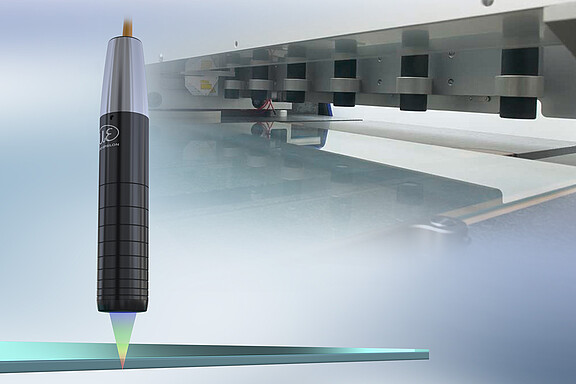
Confocal sensors from the confocalDT series offer resolutions down to the nanometre range, operate wear-free and measure the distance and thickness of micro-lenses, glass and films. This makes them ideal for use in industries such as semiconductor, glass production and electronics manufacturing. They operate based on the principle of chromatic aberration in combination with confocal imaging to acquire precise measurement data.

One advantage of confocal chromatic sensors is that they measure precisely and accurately on almost all surfaces – from weakly reflective to shiny. They are also less sensitive to vibrations and inclination. This is why confocalDT sensors are used in smartphone production to measure the thickness of glass panes in the manufacture of displays – without contact and only looking from one side.

2D/3D geometry inspection of hairpins

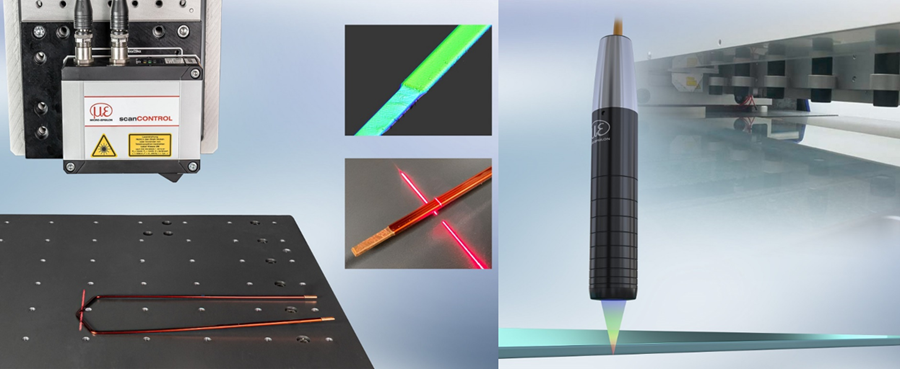
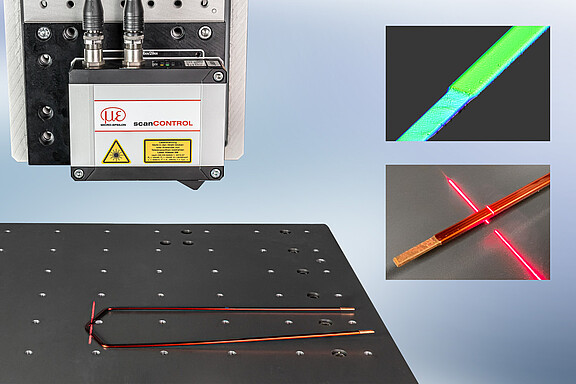
Hairpin technology enables wires to be packed more densely and therefore increase the power and torque in electric motors. During the production of the copper wires, various geometric parameters such as the cross-section of the wire, bending angle and parallelism are checked. Possible defects on the component and the position of the connecting wires are also monitored to ensure perfect function. 3D sensors and laser scanners are used for inspecting geometry, defects and positioning.

Temperature measurement in real time

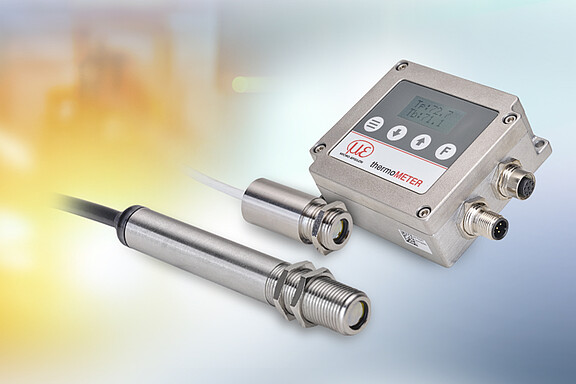
In the field of temperature measurement technology, Micro-Epsilon has developed the new, high precision thermoMETER UC, SE and FI series. They detect temperatures from
-50°C to +1100°C without contact. The compact and robust stainless steel housing with a high protection class ensures that the sensors measure precisely, even in harsh environmental conditions and deliver high signal quality and stability. Simple mounting and integration, as well as industrial interfaces with M12 connection standards, make the sensors ideal for use in sectors such as automation and process technology.

Industrial temperature measurements play an important role in the production of modern batteries for electric vehicles, energy storage systems and smartphones. During the battery film drying process, a paste (slurry) is applied to the carrier film via a slotted nozzle and cured in the drying oven. The thermoMETER FI and SE non-contact infrared temperature sensors measure the temperature of the slurry in real time and enable precise control of the process.

Assembly of flexible components

The scanCONTROL laser line scanners use the laser triangulation principle to detect two-dimensional profiles on a wide variety of object surfaces. In the automated assembly of flexible components such as cable harnesses, for example, special requirements must be met in terms of precision and flexibility. The scanCONTROL 3010-200 laser profile scanners in conjunction with robots have proven themselves for this complex task. The sensors detect the exact position and geometry of the cables in real time so that the robot can grip them securely and insert them into the connector housing with pinpoint accuracy. The measurement data is synchronized directly with the robot movement, thus enabling maximum process reliability and assembly accuracy. Due to the flexible automation solution using standard components, variants can also be implemented efficiently without mechanical modifications.

Inline quality assurance

The measurement of vibrating or fast-moving objects poses a major challenge in dynamic production processes. The optoCONTROL 2700 optical precision micrometer is specially designed for this purpose. With a sampling rate of 15 kHz and an extremely short exposure time of 8.5 µs, they detect diameters, gap widths or edge positions extremely reliably, even with strong object movements. Active inclination (tilt) correction automatically compensates for angular errors and provides stable measurement values in real time. The compact design with integrated controller reduces installation costs, while the output of measurement data via digital interfaces and a web interface enables simple integration into existing systems. The system is available in two models with measuring ranges of 10 mm and 40 mm, making it ideal for inline quality assurance and machine monitoring at high cycle rates.

Wide variety of 3D sensors

The company offers a wide variety of 3D measurement technology. With the 3D Profile Unit, for example, up to eight scanCONTROL sensors can be offset in a common coordinate system to create a precise 3D image of a measuring object. This enables a wide variety of geometries to be captured and thickness of profiles to be measured. The data is evaluated and the system parameterized in the manufacturer's 3DInspect software.

The high-precision 3D snapshot sensors from the surfaceCONTROL series, on the other hand, are ideal for the automated inline inspection of geometries or shapes on diffusely reflective surfaces. They work according to the principle of fringe light projection, which enables direct 3D measurement. The sensors are used for quality assurance in battery production, for example. Precise measurement of the connection terminals is essential here. After welding the pole terminal, shunt and bridge, the surfaceCONTROL 3D 3500-80 sensor, with its large measuring range of 80 x 50 mm, checks the coplanarity of these three components. The 3D snapshot sensor is integrated into the rotary indexing table and captures a high-resolution 3D point cloud within milliseconds, the data from which is transferred to the evaluation software via a Gigabit Ethernet interface. Due to the compact, inline-capable design, no additional controller is required. The sensor enables fast, space-saving and cost-efficient inline inspection and makes a significant contribution to quality assurance in battery production.

The sensors in the reflectCONTROL series were developed for the surface inspection of reflective parts. This compact sensor displays a striped pattern which is mirrored by the surface of the measuring object into the sensor cameras. Irregularities on the surface cause deviations in the striped pattern, which are evaluated using software. Due to their high-precision resolution, the sensors are used, for example, in paint defect inspection by leading car manufacturers. The vehicle is first measured and any faults found are projected back onto the vehicle surface. A defect can be localized within +/- 3 mm on the surface and is given 3D features such as height, depth and volume due to the unique reconstruction. Once the fault has been detected and localized, automatic processing can begin, which Micro-Epsilon implements together with partner companies. With reflectCONTROL, defects in reflective surfaces can be detected and classified almost 100 per cent.

Another sensor from the field of 3D measurement technology is the thicknessGAUGE 3D, a precise sensor system for two-sided profile and thickness measurement of strand and sheet material. Two opposing laser profile scanners detect synchronized profile data along a linear movement, which is merged into a 3D point cloud. On this basis, the thicknessGAUGE 3D calculates freely programmable target values to solve complex 2D or 3D measurement tasks. For example, the sensor system is used for precise inline 3D measurement of coating applications, film curvature and welded pouch cells in battery production.

Easy to integrate

In the age of Industry 4.0, measurement alone is no longer sufficient. The key factor is how sensor technology can be seamlessly integrated into digital production systems. Micro-Epsilon's measurement technology solutions are therefore not only designed for precision, but also for intelligent integration and data-based added value. Due to standardized interfaces, the sensors can be integrated directly into control and management systems without additional gateways or complex adaptations. Many sensors also support plug-and-play concepts that enable quick commissioning and easy maintenance.

The company also offers software solutions such as sensorTOOL for configuring, visualising and evaluating data. Comprehensive software development kits (SDKs) allow integration into user’s own applications, industrial PCs or cloud platforms.

For more information on smart sensor solutions for automation, please visit www.micro-epsilon.co.uk or call the Micro-Epsilon sales department on +44 (0)151 355 6070 or email info@~@micro-epsilon.co.uk  

Further Information