Jump directly to main navigation Jump directly to content

Eddy current sensors: precision at high ambient temperatures

Eddy current measurement technology enables precise, non-contact distance and position measurement on metallic objects. With the eddyNCDT series, Micro-Epsilon offers high resolution sensors that operate reliably even under challenging operating conditions. Key factors for industrial users are high measurement accuracy, robustness and versatility, says Glenn Wedgbrow, Business Development Manager at Micro-Epsilon UK.

Non-contact, inductive displacement sensors from Micro-Epsilon are normally based on the eddy current measuring principle. They can be used on both ferromagnetic and non-ferromagnetic metals, operate extremely accurately with a high frequency response and are very temperature-stable. They are also wear-free, robust and very responsive. Other advantages of inductive eddy current sensors include a long service life due to their non-contact operation, fast switching frequencies and high tolerance to dirt and vibrations, as the sensors operate electronically rather than mechanically.

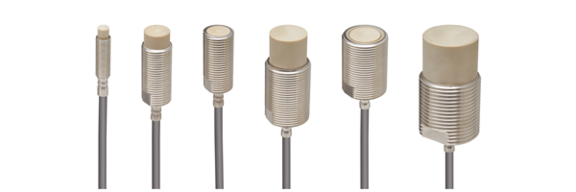
Micro-Epsilon’s range of eddy current displacement sensors extends from miniature sensors with a diameter of just two millimetres, to sensors for harsh conditions such as high pressures or high temperatures and very large measuring ranges of up to 80 mm. The company also offers a range of controllers which, together with the sensors, form a complete measuring unit and can be connected quickly and easily via cable. Fully integrated compact sensors are also available that house the entire evaluation electronics in the sensor itself.
Eddy current measurement technology

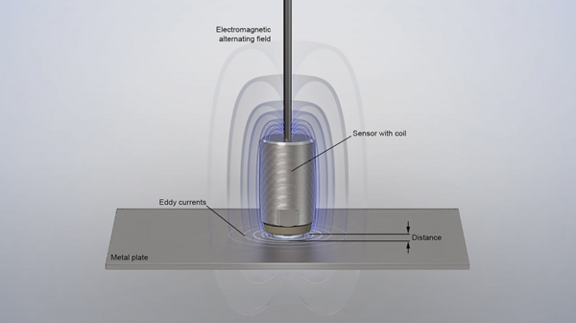
Eddy current measurement technology is based on the generation of a high-frequency alternating magnetic field by a coil in the sensor. As soon as an electrically conductive object approaches the sensor, eddy currents are induced inside the object. It’s not important whether the object is ferromagnetic or conductive, such as aluminium or copper. The eddy currents in turn generate a magnetic field which, according to Lenz’s law, counteracts the original magnetic field and thus changes the impedance of the coil. This creates an interaction between the magnetic field generated by the sensor and the magnetic field influenced by the eddy current, which affects the impedance of the coil as well as the amplitude and phase of the sensor signal. By measuring this change in impedance or signal, precise statements can be made about the distance between the sensor and the target.

As this measuring method is very insensitive to harsh environmental conditions such as oil, dirt or pressure, the inductive eddy current sensors are primarily used for measuring position and distance in machines and systems where cutting fluids and oils are often present.

Challenges of eddy current technology

As eddy current sensors often have to work in the micrometre range, they must be manufactured and calibrated with extreme precision in order to avoid measurement errors and excessive tolerances. In addition, sensor manufacturers must store complex compensation algorithms and characteristic curves in the evaluation electronics to compensate for deviations caused by measuring different metals, especially with changing temperatures. Temperature drifts due to high ambient temperatures, electromagnetic fields or high pressures and vibrations are also challenges that sensor manufacturers must deal with when developing eddy current sensors.

With decades of expertise in eddy current measurement technology, Micro-Epsilon can respond to these challenges in a targeted manner. The company also sets the highest quality standards for its products and offers customised solutions for unique projects, worldwide from a single source.

Very high temperature stability

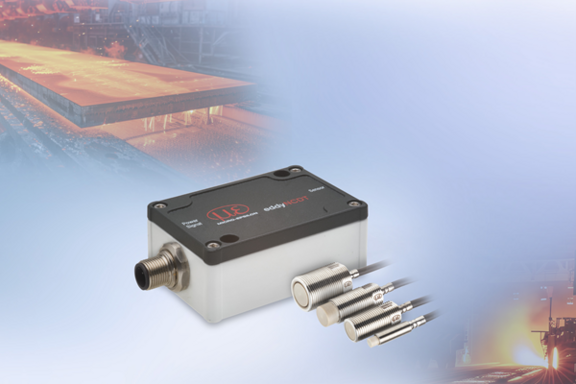
With the eddyNCDT 3020, Micro-Epsilon complements its portfolio of eddy current measurement technology with a powerful 1-channel controller that offers an extremely high resolution of 0.01 % FSO (dynamic) and a measuring rate of up to 80 kSa/s (kilo samples per second). It detects rapid changes in distance up to a frequency response of 5 kHz with high precision. As the controller and sensors offer a temperature resistance of up to 105 °C and 200 °C respectively, which is unique in the market, the complete measuring channel can be used at high ambient temperatures. Any sensor from the Micro-Epsilon portfolio can be connected to the new controller to cover measuring ranges from 1 mm to 80 mm.

The controller proves its industrial suitability with its versatile industrial interfaces, flexible setting options (via Micro-Epsilon’s sensorTOOL software) and its robust, IP67-protected design. For example, the software enables three-point linearisation to be performed, averaging of measured values, scaling of the analogue output as required, and configuration of a switching output. To connect the controller to coupled peripherals or a PLC, users have access to all standard fieldbus connections via an additional interface device. The controller transmits the processed measurement signal reliably and over long distances digitally or analogue via a current output.

Due to its characteristics, the compact eddyNCDT 3020 controller with compact dimensions of 76 mm x 53 mm x 30 mm covers numerous application scenarios, particularly if a current, digital or switching output is required, the sensor is to be connected to a fieldbus, or the accuracy requirements are high. The controller is also ideal if users require linearisation in the field, for example, to compensate for special installation conditions or materials in a machine, or if the sensor and controller need to be pluggable.

Convenient system configuration via sensorTOOL

The controller and PC can be connected quickly and easily via an RS485 to USB converter. Users can then parameterise the eddyNCDT 3020 using Micro-Epsilon's own sensorTOOL software. The numerous setting options offer users great flexibility, including:

  • Arbitrary scaling of the analogue output and measuring range
  • Various options for condition monitoring (limit value monitoring via switching output)
  • Data processing through averaging, mastering or data reduction
  • Three-point linearisation for customer-specific installation situations and materials

The IF1032 interface module is also required for the Ethernet and EtherCAT connection and the IF7001 interface cable for the USB connection. Connection via PROFINET or Ethernet/IP is also possible via the IF2035 interface module.

Strip stabilisation of galvanised steel sheets

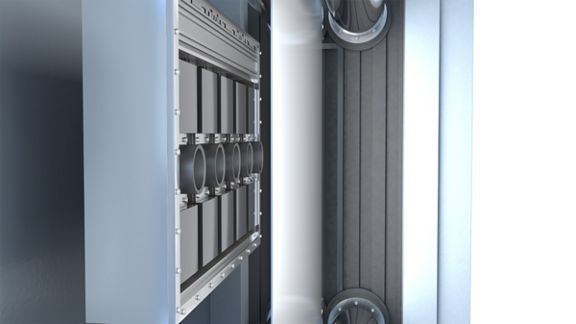
Due to its robust and compact design and flexible connection options, the eddyNCDT 3020 is ideal for machine integration, for example, for strip stabilisation in the production of galvanised steel sheets. In order to achieve stable results and a homogeneous thickness of the sheets, the sheet position must be controlled within a short control time of 300 µs and over a wide height range. In addition, steel production normally involves high temperatures. Even on the remote controller, temperatures of 80 °C and higher can occur, which the eddyNCDT 3020 can easily handle. Micro-Epsilon implements 8 to 16 eddyNCDT 3020 controllers directly in the machine alongside two electromagnets and one suitable eddyNCDT EU40 sensor per measuring channel. This is where the measurement technology fully exploits its advantages: there is almost no interference from external magnetic fields and the innovative three-point alignment compensates for the cramped installation position. This enables the manufacturer to achieve consistently high galvanising quality.

Flatness measurement during flat rolling of crude steel

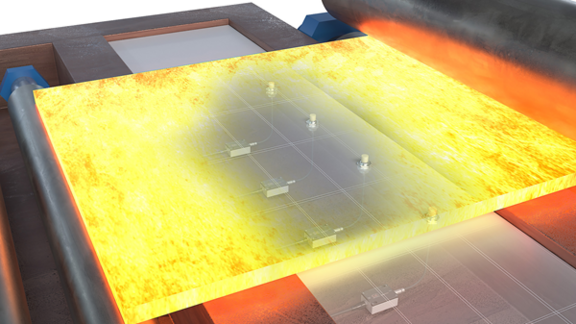
Steel is rolled flat over large slabs and under high heat in order to prepare it for subsequent processing. The key factor here is the flatness of the steel in order to avoid waves or bulges. Micro-Epsilon eddyNCDT 3020 sensors measure the distance between the sensor and the steel strip and thus the tensile stress at each point of the flat rolled steel to ensure a uniform amplitude. A major advantage of Micro-Epsilon eddy current sensors is their high temperature resistance and insensitivity to dirt and vibrations. In combination with the modern evaluation software, the flatness of the steel can be ensured, thus achieving an essential product property.

Measuring the fill level when casting aluminium

When casting aluminium, precise control of the fill level in the casting mould is crucial for product quality. Inductive eddy current sensors measure the distance to the surface of the liquid aluminium without contact. As aluminium is an electrically conductive metal, it can reliably induce eddy currents. This produces a measurable signal that is proportional to the fill level. The sensors provide a continuous analogue signal that is fed directly into the casting control system and thus automatically regulates the aluminium feed. Due to their high temperature resistance, Micro-Epsilon eddyNCDT 3020 sensors, which are designed for use in the vicinity of liquid metal, are also suitable here. The robust, temperature-compensated design ensures reliable long-term measurements under extreme conditions.

For more information on the eddyNCDT 3020, please visit eddyNCDT 3020 | Micro-Epsilon or call the Micro-Epsilon sales department on +44 (0)151 355 6070 or email info@~@micro-epsilon.co.uk  

Further Information