
Font-Size
Contrast
Blue-Filter
Jump directly to main navigation Jump directly to content

Sensors measure coplanarity of wafers in hybrid bonding and perform multi-segment measurements on superconducting strip

The production of superconducting strips for power applications requires the highest precision and the greatest possible material protection. Typically, 12 mm wide stainless steel strips are processed with a nickel alloy, which are cut into several narrow partial strips – such as 3 or 4 mm wide segments, separated by gaps of only 0.5 mm. As the belts are also provided with sensitive PVD coatings, the width and segment measurement must be carried out on a non-contact basis and with high precision.

Real-time quality control for maximum process reliability

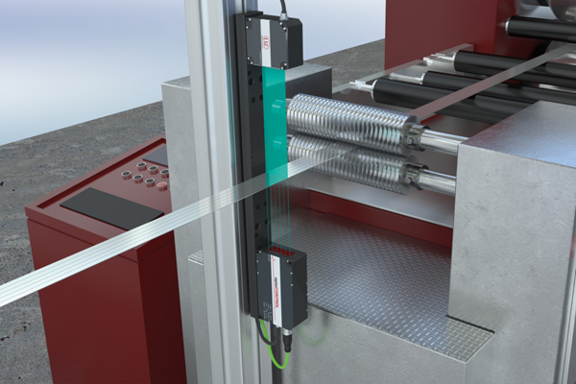
Using the compact, high performance optoCONTROL 2700-40 LED micrometer from Micro-Epsilon, the strip is measured immediately after cutting in the running process. With a width of 12 mm, the continuous strip is recorded in the measuring field of the optical micrometer. Due to the ‘Multi-segment’ preset, both the total width and the width of the individual partial strips can be measured precisely. The 0.5 mm narrow gaps between the segments are also reliably detected and monitored. Due to the transmission of the measurement data in real-time to the control system, the measured values can be used immediately for process control.
Maximum precision with minimum waste

The optical precision micrometers offer a number of decisive advantages for demanding cutting and coating processes. As the measurement is carried out on a non-contact basis, the sensitive nickel and PVD layers are not mechanically stressed – there is no risk of scratches or deformations. At the same time, the optoCONTROL 2700-40 LED micrometers impress with their high precision: a resolution of 10 nm and a repeatability of ≤ 0.1 μm, allowing even extremely narrow partial strips to be reliably detected. With a measurement rate of 5 kHz, the sensors enable fast and seamless control of the running belts, so that deviations are detected immediately and rejects are minimised. Due to flexible interfaces such as EtherCAT, PROFINET, Ethernet/IP or analogue signals, the system can also be seamlessly integrated into existing cutting and production systems.

Planarity testing in hybrid bonding

In hybrid bonding in semiconductor manufacturing, exact planarity of the wafers is crucial to ensure stable bonding processes. Capacitive distance sensors from Micro-Epsilon enable high resolution measurement of shape deviations on wafers and provide measurement data for adaptive levelling of the bonding units.

Hybrid bonding is an advanced joining technology in semiconductor production in which two wafers or chips (dies) are directly connected to each other via copper contact surfaces, which eliminates the need for conventional solder balls. In modern die-to-wafer (D2W) or wafer-to-wafer (W2W) hybrid bonding, real-time planarity measurement is a key factor for process reliability.

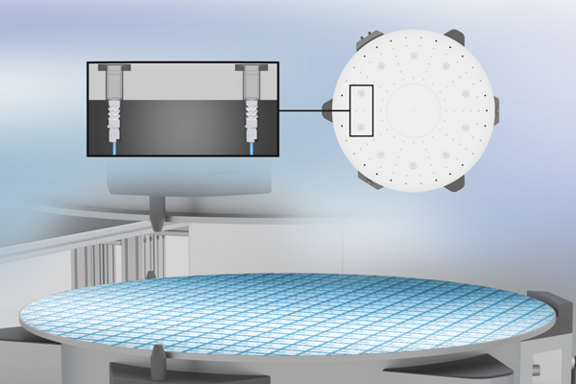
Capacitive distance sensors play a central role here by enabling non-contact measurement of shape deviations on wafers, for example, due to deflection, twisting or local warping. In this way, the sensors control the planarity of the wafers and provide essential measurement data for adaptive levelling of the bonding units.

Inline planarity control before bonding

Depending on the measurement task, sensor arrays scan the surface of the upper and lower wafer and record local elevations, depressions, inclinations or the entire deflection. The measurement data is incorporated into an active position correction of the wafer stages. If height differences are detected, the bond unit can be precisely aligned in the Z-axis, for example, using piezo-actuators or precision axes. For very small chips, segmented surfaces on the chuck are also used, which can be levelled locally.

Due to the vacuum-compatible design, the compact sensors can be used in almost all areas of application.

For more information on sensors and measurement systems for semiconductor manufacturing, please download industry-brochure--semiconductor--en.pdf or call the Micro-Epsilon sales department on +44 (0)151 355 6070 or email info@~@micro-epsilon.co.uk

Further Information