Font-Size
Contrast
Blue-Filter
Jump directly to main navigation Jump directly to content

White light interferometers for stable thickness measurement of very thin layers

Based on highest resolution and a non-contact, non-destructive operating principle, interferometry measurement technology is used in numerous industries for quality assurance in high-tech areas. It reliably delivers high precision distance and thickness values, for example, in the production of semiconductors, optical components and precision mechanics, says Glenn Wedgbrow, Business Development Manager at Micro-Epsilon UK.

Interferometry measurement is used in numerous industry sectors where it helps to optimise processes, reduce waste and create innovative products, while fulfilling the highest performance requirements.

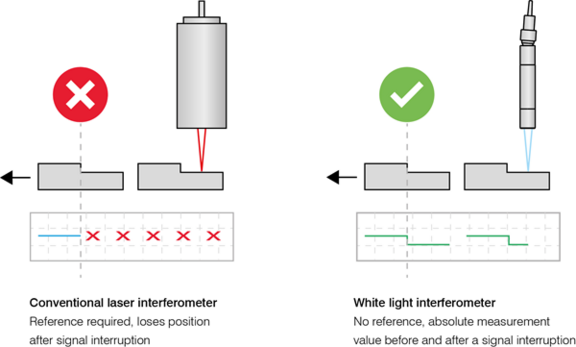
In interferometry, a distinction is made between laser and white light interferometers. Unlike laser interferometers, white light interferometers measure absolute distances without having to use a reference. They deliver extremely precise and clear measurement results in the sub-nanometre range. To do so, they use polychromatic (white) light with a short coherence length. The interference of light waves and the analysis of the received, superimposed waves can be used to precisely determine distances and intervals.

Automotive, semiconductors and metals

The non-contact measuring principle with remote electronics makes the systems insensitive to harsh environments such as high temperatures, shock or vibrations. Typical applications range from wafer and mask measurements in semiconductor production to the measurement of lenses, mirrors and glass surfaces. Sectors such as automotive, medical technology, metals and packaging industries also benefit from the outstanding properties of the technology.

So what are the advantages of absolute measuring white light interferometers over conventional laser interferometers, and what kind of applications are they used in?

The measuring principle of interferometry

Interferometry has proven itself in numerous applications such as measuring layer thicknesses and distances. In interferometry measurements, a beam splitter divides a continuous spectrum of light waves into two partial beams, a reference beam and a measurement beam, which each take different paths. The light source itself can be either a laser or a superluminescent diode (SLD), which emits polychromatic (white) light with a short coherence length.

The two partial beams emitted by the light source hit the object to be measured, are reflected and then overlap. Depending on the measuring object, the phase shift of the partial beams varies with the wavelength. Due to this variation, constructive interference occurs at certain wavelengths and destructive interference at others. If the intensity of this interference signal is plotted against the wavelength, alternating minima and maxima appear.

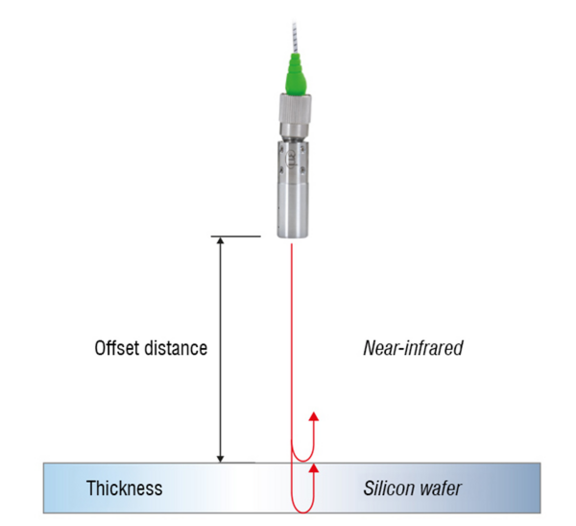
The resulting periodic intensity signal in the spectrum of the reflected light is assigned to a distance or a thickness by means of Fourier transformation. This enables the precise determination of a measured value that reflects the exact thickness of an object or the distance from a surface. If the interferometry method is used to measure thicknesses, the two beams reflected from the front and back of the layer can interfere with each other. This means that the measurement result is independent of the distance from the measuring object, which provides great flexibility for industrial measurement tasks.

Using the advantages of white light interferometry

White light interferometers that work with a superluminescent diode use an extended wavelength spectrum. This is how they acquire more distance information than conventional laser interferometers. This means that white light interferometers can measure absolutely without having to use a reference – which is crucial for many industrial measurement applications.

This absolute measurement method is particularly favourable in the case of signal interruptions that can be caused by steps, holes, false reflections or structured surfaces, for example. After a signal interruption, users immediately receive a measurement value, whereas laser interferometers first have to re-reference themselves. For example, distance profiles of moving measurement targets can be generated with high precision and reliability.

Unlike white light interferometers, conventional interferometers use highly coherent, monochromatic light in which the waves are in phase. They can only measure relatively and require a preset reference. This method is tedious and costs the user valuable time and resources.

With white light interferometers from Micro-Epsilon, distances and thicknesses can be measured absolutely and with the highest precision. This measuring method also makes it easy to measure fast-moving objects, which opens up a wide range of applications for inline inspection such as distance, multi-peak or thickness measurements of different measuring objects. The user achieves maximum signal stability for industrial processes, semiconductor production, machine building and laboratory testing.

Measurement of thin layers from 1 µm

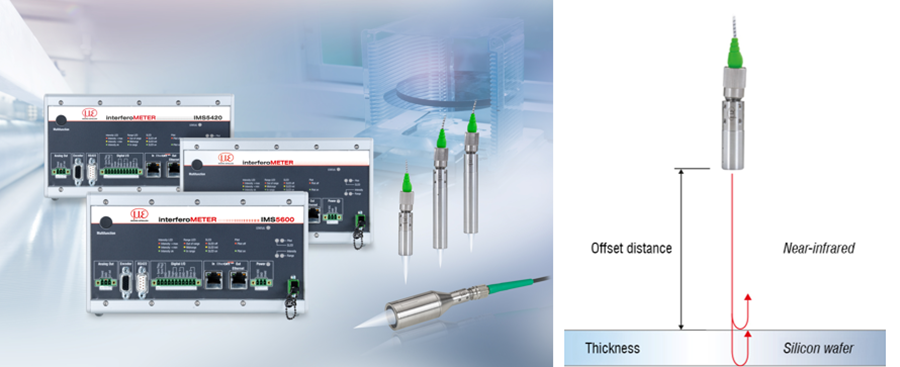
The interferoMETER IMS5200-TH from Micro-Epsilon enables thickness measurement of extremely thin layers from 1 to 100 µm. With extremely high resolution and measuring rate, dynamic measurements can be ensured with high precision.

Multi-peak thickness measurement is used when several layers are present. Up to five layers can be measured simultaneously, for example, to calculate the distance between a glass and the carrier plate in display glass production (i.e. air gap). Interference at different interfaces produces several reflection signals (peaks) in the signal, from which the thickness of individual layers can be determined. Based on the measurement, the controller outputs up to five thickness values. These are obtained with a high measurement stability regardless of the layer’s position within the transparent object.

Checking the coating of beverage cartons

Another example where maximum precision is required is in the monitoring of coating thickness in the packaging industry. Here, the white light interferometer tests the coating process of beverage cartons, which are made up of several thin layers of paper fibre, plastic and aluminium. To ensure that the carton remains tight, hygienic and durable, the layer thicknesses must be uniform.

The interferoMETER IMS5200-TH checks this uniformity by emitting broadband light onto the surface and evaluating the reflected signals of each individual layer and the associated layer boundaries. By evaluating the position of various interference peaks using the multi-peak function, the thickness of each individual layer can be precisely determined.

White light interferometry is perfectly suited to this application as it is non-contact and non-destructive. Several layers can be detected simultaneously over large surface areas. This allows defective areas, uneven layers or air pockets in beverage cartons to be detected at an early stage. White light interferometers enable inline quality control, which avoids rejects and increases the quality of the end product.

Monitoring the coating thickness of metals

Another application in which the measuring principle of white light interferometry is used is inspecting the coating thickness of metals. This is important because layers of varnish protect components from corrosion, improve their appearance and increase their mechanical resistance. In the automotive, construction and household appliance industries in particular, it is crucial that varnishes are not applied too thinly (insufficient protection) or too thickly (waste of material, optical defects).

The interferoMETER IMS5200-TH enables non-destructive measurement of the varnish layer thickness during the coating process. It emits broadband light onto the coated metal surface, creating reflections both on the coated surface and at the interface with the metal.

The interferometer measures the interference between the reflections on the varnish surface and the underlying metal layer. The exact varnish thickness is determined from the distance between the signals, which works even with very thin transparent layers. This allows the varnish density to be checked inline and non-destructively to ensure consistent coating quality.

This method offers considerable advantages over other measuring methods: it is non-contact, highly precise and allows multi-layered varnish structures to be analysed. White light interferometry is suitable for both random checks and for inline quality monitoring in the production process, for example, when coating car bodies or testing metallic construction profiles.

Air gap measurement of glass masks and wafers

One of the many applications of the interferoMETER IMS5200-TH is measuring the air gap of glass wafers and masks in semiconductor production. Here, the polychromatic light is directed vertically onto the glass and wafer. Part of the light is reflected on the underside of the glass, another part on the wafer. Between them is an air gap with a thickness of several µm. The two light beams overlap and create an interference pattern that depends on the slit size.

This enables non-contact detection of whether the wafer is correctly positioned or whether the optimum distance between the mask and wafer for the process is being maintained. With this measuring method, the company significantly increases the quality of products in the semiconductor industry.

For more information on smart sensor solutions for automation, please visit Precise measurement with white light interferometer | Micro-Epsilon or call the Micro-Epsilon sales department on +44 (0)151 355 6070 or email info@~@micro-epsilon.co.uk  
Further Information